Thursday, March 14, 2013

Pope Francis I - an historic day for religion...AND the environment?!

Francis of Assisi, patron saint of animals and the environment
Today's election of Argentina's Jorge Mario Bergoglio as the new Pope has already proven to be an historic moment for the world's Catholics. I'm hopeful for an entirely different reason. I'm hopeful because, although he has not yet revealed why he chose it, he took the name Pope Francis I.

Francis of Assisi, born to a wealthy cloth merchant, eventually forsook the worldly (consumeristic) life to pursue a life a poverty and service to God. But he had a particular fondness for and connection with animals and the natural world...in fact was enraptured enthralled with it. Though he was never ordained into the Catholic priesthood, he is perhaps the most venerated of all religious figures and is today known as the Patron Saint of Animals, the Environment, and Ecology.

Side bar: I had largely forgotten about it, but as a child I was incredibly moved by a movie. Being raised in a religious hippie commune for several of my early years, we did not have much access to television or radio. So when us children DID get to watch a movie, it was a significant moment for us. And one particular movie - Brother Sun Sister Moon - really resonated with me. Even (especially?) now, remembering back to watching that movie and learning more about the story of St. Francis of Assisi, I am moved to my core. Not so much by the movie, but by his story. This image (below) captures it particularly well for me. In complete vulnerability, there is this sense of amazing glory, fullness and strength...and he is offering himself to and embracing the amazing world - God's Creation - around him. But I digress...
1972's Brother Sun, Sister Moon movie cover
Religious leaders hold tremendous influence with people of faith regarding perspectives and attitudes about the environment. Recognizing this, a number of scientists have attempted to engage religious leaders in developing and framing science and sustainability messages that resonate with people of various religious backgrounds by convincing them of the direct applicability of environmental issues to questions of faith (journal examples [sadly behind paywalls] here, here, here and here). Among the more notable examples is the work from world-renowned ecologist E. O. Wilson (examples here and here).
A few Twitter links from today's historic Papal election.
Assuming the Pope takes up and fully embraces his namesake, I'm hopeful that a new era of wise environmental stewardship, perhaps initiated and championed by the roughly 1.2 billion Roman Catholics, may be just around the corner. Today's election results seem like a significant event. Maybe it will even prove to be a watershed moment in the move toward a more environmentally-minded consciousness. Today has certainly proven historic for the world's Catholics. But will today also prove to be an historic day for our planet? Only time will tell...but I'm hopeful.

Read the Canticle of Brother Sun, Sister Moon by Francis of Assisi


Monday, March 4, 2013

Dirt poor you (and me): Wealth Inequality - is there a role for government?

Video on wealth inequality in America. What we think it is, should be, and actually is are vastly different. Is this OK? Are you OK with it? Do you think you'll be able to move up into another wealth category? The statistics indicate no. Does government have a role to play here? Perhaps redistribution (such a vilified word for half of Americans)? Or maybe implementing Ross Perot's flat tax idea? See some good Mashable discussions on wealth inequality, then watch the video below. What do YOU think about wealth inequality?


Lest you think, in a momentary lapse of quasi-(in)sanity, that you actually CAN work your way into something of a top 20 percenter, this New York Times article (Ambition at a Cost) does a good job of illustrating just how deep the division is between the haves and have-nots.

And yet, for some strange reason, I keep striving to "lift myself up by my bootstraps" and attain greater wealth...

Sunday, March 3, 2013

Is efficiency the most important thing?

From InvestingThesis.com

As I work my way through the OSU's Master of Public Policy (MPP) program, I'm struck at how much emphasis - at least in the early program coursework - is given to economic efficiency for solving problems (or rather, prioritizing solutions to problems). I can't help but wonder...is efficiency really the most important variable in valuation of a thing? In a capitalist society, it certainly seems to be. World-renowned economist Bjorn Lomborg illustrates this well with his work on the Copenhagen Consensus (around the 12 minute mark you get his interpretation of what's most important) - we should be spending our money to influence problems of immediate concern rather than focusing on problems with longer-term affects. I can't be the only one that finds discounted present value - the concept that a dollar today is worth more than a dollar tomorrow - an insidious notion...


Access larger versions of Lomborg's TED talk.

But what of non-capitalist ways of living (thinking)? What of making decisions now with an eye toward how current decisions will impact future generations? The Iroquois, Onandaga and other indigenous peoples understood the importance of thinking down the road. Why can't we? Is money really that corrupting an influence? Has economics ruined (clouded, at best) our long-term thinking? How can we dial back this myopic economic viewpoint and return to generational planning? Is it possible? I'd argue we're near a (Malcom Gladwell-ian) tipping point.

Political Typologies - don't box me, bro!

How do you identify yourself politically? How does it align with the results from this Pew Research Center for the People and the Press survey/analysis? I consider myself a liberal Republican turned moderate Democrat (a centrist, really...something we've lost in our current political divisiveness). And, indeed, that's where my typology fell ("Post- Moderns" to "New Coalition Democrat", depending on my answer to one question) - socially liberal but generally fiscally conservative. I find it silly to try to label people along a continuum as they can simultaneously hold multiple "positions" along that spectrum - that is to say, being at one place along a spectrum isn't mutually exclusive from simultaneously being at another place along the same spectrum. 

Why do I consider myself centrist? I hold some socially liberal perspectives but also consider myself fiscally conservative. The results from that fun-to-take-but-not-too-insightful Pew Research survey landed me pretty much where I expected, too. BUT...I did not like answering many of the questions as the two options presented often did not capture my position. I took the survey several times, changing one question each time to see where it would place me and was not surprised to learn that changing one answer was often enough to move the label assigned me to another category. For instance, when I first took it, I landed in the "New Coalition Democrat" but when I changed my answer to the question about people whose skin color is of the darker persuasion and racial discrimination from "racial discrimination is the main reason people can't get ahead these days" to people of the darker skin persuasion "can't get ahead and are mostly responsible for their own condition", I was assigned to the "Post-Modern" category. In reality, I don't agree with either of these statements. But I did find it apropos that the name of the survey was "Going beyond red and blue" and yet the answer options were so restrictive, forcing you into one of two answers with no grey area between them. Guess that's the tradeoff between having too few people answer the questions (too complex and long) and a survey short enough to hold people's attention. No matter, it's just a quick-n-dirty survey/analysis. I am a complex onion with many layers. Some are so sweet and others might make you cry. I am secure in it.
I am an onion... (art by favianna.com)
Nevertheless, the utility in these sorts of "analyses" (if we can call them that) and of public policy theories in general is in helping us structure how we view the world. Indeed, these sorts of typologies offer some insights into how groups of people might loosely be clustered. But what value does that have in and of itself? How about for deciding how allocating government funds? Or deliberating on cutting, expanding, or creating new programs? Is it useful for getting understanding how to get elected? Certainly. How much utility beyond that? I believe the real utility is in illuminating where similarities exists and where the potential for commonalities/overlap can help advance or arrest particular policies.

This Pew Research survey/analysis claims to go "beyond Red vs. Blue". I don't think it goes far enough in identifying commonalities among differing political ideologies. Do you?

Thursday, January 31, 2013

Are GMO salmon safe? Really?

Comparison of regular- and fast-growing GMO Atlantic salmon.

Late last month, perhaps lost in all the Christmas hubbub and hullabaloo, the Food and Drug Administration (finally) issued a ruling that AquaAdvantage's/AquaBounty's genetically modified salmon posed little to no threat to the environment. Headlines read (Huffington Post) "GMO salmon not a threat to nature, FDA says" and (PopSci) "GMO salmon environmentally safe". 

But is that really what the FDA said in their ruling? Or is this just the media's take (spin?) on a story to make it a sexier headline?

Here's what the FDA actually said in their ruling - what's known as a Draft Environmental Assessment, more specifically, a Preliminary Finding of No Significant Impact (fondly referred to as a FONSI) - "the proposed action will not significantly affect the physical environment of the United States." (I've excerpted parts of the FONSI, below but you can read it in its entirety)


This is the part that most news organizations clued in on. But that's not the whole story. After all, where there any caveats? And what is meant by "physical environment" or "proposed action"? Turns out, understanding both is significant to understanding the ruling.

And what of potential unintended consequences and compounding effects to the environment and human health? I find it disheartening that the burden of proof for EPA and FDA rulings is the companies do not have to demonstrate that their product will do no harm, rather only that they have some safeguards in place to minimize harm. And no long-term studies are required.

Does this seem like a sensible way to keep people safe - simply trying to minimize potential harm? What if the harm inflicted is quite large? And how do we measure "minimized harm"? Is it just simple economic accounting (e.g., cost/benefit)? I'm not jumping to conclusions about the safety of this fish. By all accounts it's probably very safe to eat. But will it be safe in the environment when (not if) these fish accidentally get out of their holding facilities (and they will, whether by some "act of God" or a human bucket brigade)? The FDA didn't rule on that...only that under the company's current plan of raising these GMO fish outside of the US, there's likely no significant harm to physical environment of the US. Seems like there's an awful lot of "what ifs". As Jerry Seinfeld says to George Constanza in one Seinfeld episode, "that's a pretty big motza ball hanging out there"...and I say too few safeguards!

I'm not sure I'm comfortable with that.


Saturday, December 15, 2012

Tiny bits of unconditional love (a guest post from Tony Cannon)


All you need is love...and two other things.

I've spent a lot of time in thought lately about why people have problems with each other and, while that is natural and even acceptable, how we can get over those problems to still be able to cohesively be a part of the same community without a lot of lingering angst.  I keep coming back to the same idea without a way to really defeat it: love.  Not based on how well someone does their job, whether they smile at us in the hall, whether we like them or not, agree with their personal beliefs, but love that is unconditional.  And it doesn't have to be a lot.  Just a tiny, tiny bit.  If we felt the tiniest bit of unconditional love towards every other person, how much better would things be?  It would be easier to forgive people when they wrong us (perceived or actual), it would be easier to disagree and still get things accomplished.  It would make life more enjoyable.  We wouldn't have to show it necessarily, just feel it internally and recognize it when it came time to rely on it.

Hypothetical: If there was a staff member who I strongly disliked/wronged me/thought did a terrible job/etc., and I saw them crying alone, what would I do?  Keep walking; give support, but with conditions; or just give support regardless?

It doesn't mean we don't have conflict between one another, but that the conflict is confined to a single situation and doesn't overlap to the point where it's only what we have with that other person.

Emotionally, people need 3 things from others (regardless of their age, talents, deficiencies, position, or any other definable feature):
- love
- respect
- purpose

It can be argued that respect is a filtered form of love and also that you cannot have purpose without respect.  As a school, do we have systems in place to cover those?  Purpose, yes; respect, sort of; love, no.  And even with regard to purpose, how much of that system is based on respect?  What do our personal, internal systems show with regards to those 3 things through our actions towards others?  

When I was a Special Education Instructional Assistant substitute educator in Salem, these 3 things are what I lived by (though I was only able to define them recently, I just went by "feel").  I would go from school to school, program to program, room to room, kid to kid.  Kindergarten, high school, college prep, all types of Special Ed rooms, and everything in between.  Unlike a teaching sub, I wouldn't have the luxury of being able to deflect student issues amongst 30 students, I had to focus mostly on one student, and it was usually the most difficult one.  And while the other workers would have weeks to build a rapport with a high-maintenance student, I'd have minutes at best before I saw flames reaching over the edge of the handbasket the student and I were in together.  When things would start going south, I'd try and recognize how I was failing that other person, how they were failing me, how we were failing each other, leaving out emotions like guilt, hurt, shame, embarrassment.  "How can I solve this within two minutes?"  Smiling was almost always part of the solution.  I'd always try and cover the difference as much on my own as I could and that would usually make the other person feel comfortable and willing to cover the rest of the way.  We have to be willing to recognize when we're failing other people, then be willing to do something positive about it, even if they're hurting us.  We also have to be willing and able to recognize when someone else is failing us, yet is unable or unwilling to cover it on their end.

Regardless of what problems, either as individuals or overall as a school, we think we may have, don't they all boil down to one or more of those 3 things lacking in a given situation, from one or both sides, and in varying degrees?  How can I solve an interpersonal issue quickly, respectfully, in a way that will last?  While doing this, I have to realize that there’s a good chance I’ll have to give more than the other person, and that this may never be reciprocated down the road.  I’m okay with that.  Tiny bits of unconditional love.


Tony Cannon is a father, husband, professional educator, amateur photographer, and recreational philosopher, among other things. He frequently blogs about hiking at http://wildumpqua.blogspot.com/.

Thursday, December 13, 2012

Aspiring to the divine (craft beer, that is)


The world of craft beer has been set afire.

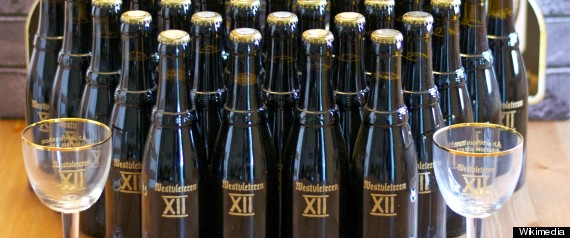
The Brouwerij Westvleteren (Westvleteren Brewery), makers of "one of best beers in the world", announced that it would be selling its beer, for the first and only time, outside of the monastery's walls. The monastery's one-time effort is designed to raise funds to fix up their roof. But for beer connoisseurs, it's an opportunity of a lifetime. And after NPR aired a segmented yesterday extolling the virtues of God's nectar (A Sign From Above? Needing New Roof, Monks Sell Rare Beer in U.S.), and the Huffington Post ran a piece in today's food section (Westvleteren XII, 'World's Best Beer," Makes One-Time U.S. Appearance),  people have been scrambling to find and try it - me included.

In an effort to procure some the divine nectar, I phoned my friend and local homebrew shop owner, the Old Lickspigot himself - Joel Rea of Corvallis Brewing Supply - realizing the shop was not yet open but hoping to leave a message. Much to my surprise and based on the overwhelming number of calls he'd received from people requesting this beer, the owner had changed his message to indicate that he did indeed have a case but that he'd be holding a raffle for the bottles and people needed to send him an email expressing their interest in participating in the raffle. So I obliged, in as eloquent a fashion as I could muster in 30 minutes of morning procrastination.

Westvleteren XII's arrival at the local homebrew shop (G-T article).


Now, without further ado, I give you my email - in its entirety - to the local homebrew shop to get in on some of the world's least available beer!


STOP! I KNOW YOU'RE BUSY, JOEL, BUT YOU MUST - ABSOLUTELY MUST - READ THIS ENTIRE EMAIL! (or not, but I think you'll get a kick out of it)
Good gravy! Sounds like you've been inundated with calls about procuring some of this beer! That's awesome (or not, depending on your perspective). I guess the inundation is to be expected when a national radio program extols the virtues of this limited quantity nectar of the one true God!
But to the point of this email: I am interested in procuring one of these Westvleteren bottles.
And I'm interested for two reasons, the first of which is Divine in nature (helping the monks of Saint Xystus/Sixtus replace their roof), the second of which is purely to serve the interests and taste buds of others (yes, I'm that much of a giver). And by others, I really mean me...and a few others that will get to quaff the sweet nectar of this bottle one evening next week whilst tying flies at my home. Flies that will hopefully land the One, True, Might and Strong winter steelhead in the coming days before Christmas (the equivalent of the golden egg-laying goose for our avian, folklore-loving friends). It is my firm belief that in savoring this drink direct from the hand of God (through his holy monks), the flies we tie up next week will have supernatural, spiritual powers bestowed upon them, thereby compelling the wary and willy winter steelhead to feel spiritually compelled to deliver themselves unto us fly-tying brethren.  And they will feel compelled to deliver themselves unto us because we will have sufficiently demonstrated - via our consumption and appreciation of this Holy nectar - our direct link to God, indeed to the Divine Kingdom. And in so demonstrating, these most magnificent of winter wilderness, waterworld wayfarers will attain true enlightenment and access to Heaven through our (including your) consumption of them (after they leave the smoker, of course!).
So please do let me know if/how I can get my hands on one of these bottles! In doing so, you will be playing an incalculable role as divine facilitator and savior of the pisces. And you'll strengthen your case for sainthood so that one day your name may be talked about in concert with that of Saint Francis of Assisi.
Many thanks, Joel!
Prost!Jeremiah (Sixtus III?)